Showing posts with label emotions. Show all posts

Support for Friendships for Girls

Friday, October 24, 2014


"Empathy isn't knowing how you would feel if you were in her shoes. It's understanding how she feels in her own shoes."  
~ Kyle Miller

This quote is one I find explains empathy perfectly. A personal story of relationships between girls was shared in a recent post. It emphasizes how essential the life skill of empathy is for relationships and well-being in life. 

Support for Friendship for Girls

Of course the early years of birth - 5 are the time of greatest impact in wiring the brain for relationship and empathy abilities. However, the childhood years are an important time for practicing these essential life skills. The friendship experiences during this time have a critical impact on brain pathways toward adulthood. Through social interactions, the pre-teen years are a time that continues to contribute to the development of the pre-frontal cortex. This is the area of the brain responsible for the ability to self-regulate.

Annie Fox, M.Ed., is an internationally respected parenting expert, family coach and trusted online adviser for teens. She has just released a wonderful new book to guide healthy relationships for girls ages 8-12. The Girls' Q &A Book on Friendship, is one that I had the honor of reviewing and am thrilled to share here.

My review:
 
“The world is going to be filled with girls that are kind, smart and self-assured as a result of this book. It’s fantastic! Annie provides fun, caring, straight forward, practical and supportive solutions for common relationship problems at a time when genuine friendships are needed more than ever! She communicates at the girls’ level so well!!”


The Girls' Q&A Book    http://bit.ly/GirlsQA1

In addition, I had the pleasure of interviewing Annie about the value of this resource for girls, educators and parents during her book tour. Enjoy learning more about Annie and this great book.

1   Deborah:   Do you find that there is a greater need for helping girls develop healthy friendships more than ever before?

Annie: Short answer, yes. Why? Because many girls’ friendship conflicts are played out on social media instead of being resolved in private, calm, and respectful face-to-face conversations. Or in conversations facilitated by caring adults. Social media is the world’s largest unsupervised playground and when girls go there to vent about a friend, things can spin out of control in seconds (and often do). It’s really all about learning to manage destructive emotions in responsible ways so no one gets hurt intentionally.


We all feel the effects of jealousy, hurt, betrayal, rejection… but people who have high Emotional (or Social) Intelligence skills know how to calm down before taking action. That’s the piece that’s missing for girls (and boys) these days. When they feel upset they grab the nearest device and use it as a weapon to get back at whomever they’re upset with at the moment. So much damage to girls’ health and well-being could be avoided (or minimized) if they had more tools for calming down, developing empathy, and communicating effectively and respectfully. Those are the skills girls need to develop healthy friendships (and, in later life) healthy professional relationships and romantic ones as well.

2   Deborah: Is there an aspect of friendships that you find to be most common from the girls that have contributed questions to the book?

Annie: Most common is the misconception that “If I speak up for myself in a friendship, I am not being a good friend.” This creates huge problems for girls because when they are upset, they need to express themselves effectively and appropriately to the friend who needs to hear it. (Talking behind her back doesn’t count!) But girls are often unwilling and/or unable to initiate those conversations. So they feel miserable and stuck in their misery. They believe that a “good friend” should never tell a friend something negative because then she will “hurt the friend’s feelings. And that’s mean.” So, if I, Annie, am hurt by something my bff Deborah did, I can not tell her, otherwise I will not be a good friend.” But Deborah is not a mind reader. If I suffer in silence, Deborah has no way of knowing how I feel. My silence will, in fact, send the message that it is OK for her to continue hurting me, even though it is not OK! My silence also leaves me feeling upset and powerless, not realizing that I do have power to change my response to this situation.


     Deborah: After providing support and advice, what is the most heartwarming story of change you have seen take place?

Annie: A girl emailed me about having fallen for her bff’s boyfriend. She was crying herself to sleep every night and thinking about him all the time and each time, feeling super guilty about “betraying” her friend… even though neither her friend nor the boyfriend ever knew she had these feelings. She also felt there was something “wrong” with her because she had never had a boyfriend. She wrote to me recently with an update…  

 I've really gotten to be comfortable and happy with myself as I am, and I'm happy that I've grown as a person since then. I've even given a speech similar to yours to my other friends. I'm so much happier with my school life, my friends, how I spent my free time, etc. now than I was a year ago, and I just wanted to tell you that I'm doing so well now! Thanks so much for being there for me and all the other people who come to you for help.” 

As you can imagine, that email totally made my day!
     
     Deborah: There are many options for ways this book can be beneficial. Is there a way that you suggest the book is used to be most influential?

Annie: This book can be read by a girl all by herself and it will, hopefully, feel like she is with a friend who understands and can give her advice she can trust. The book can also be read by a girl and her Mom or Dad. I can imagine so many great family conversations that could be sparked by the Q&A in this book! Another way would be for two or three girls to read the book together. That would provide a safe context for girls to talk about some of the experiences and feelings they’ve had (or are having). Ultimately, any reading of the book that provides food for thought and action steps is going to empower girls and make their friendship healthier, stronger, and more fun!

To enjoy and benefit from all that Annie shares go to Annie Fox.com

Brain Insight to Share: Learning to Handle Emotions

Monday, October 6, 2014

  
 A BRAIN INSIGHT TO SHARE THIS WEEK!
 
 "Young growing brains are too immature to 
handle big feelings. Children learn how to control impulses and handle strong emotions through the 
comforting adults in their lives."


Learning to handle emotions! Brain Insight to Share  http://braininsights.blogspot.com/

There is a growing group of individuals, organizations and companies wanting to make early brain development commonly and easily understood by EVERY adult for the benefit of EVERY child!
Join us to be a part of easily making brain development common knowledge! 
It only takes a couple of minutes each week! 
Simply cut and paste the Brain Insight above or use the social networking buttons to the right and share EVERYWHERE that is convenient for you! 

THE CHILDREN THANK YOU!! 

 “If we truly want to create a world of difference for children, it will happen through a common vision, shared knowledge, and dedicated hearts coming together with an intense desire to make change actually happen!”

Related Article link for further information: 

The Problem with Time-Outs 

From Psychology Today 


Is Your Child's Brain in Control?

Saturday, September 27, 2014


Sometimes it may seem that your child is being just “awful” and that their behavior is out of control. The thing is, their behavior actually may be “out of control”. 


The brain of your child is still maturing. This development takes many years. The part of the brain that regulates behavior and emotions is the last area of the brain to fully finish development. When this highest functioning brain area is developed, it will help to take control over big emotions and you will see the resulting better self controlled behavior.
 
But until then, your child REALLY needs you and all of the adults in their life to understand that they are not "being bad" and to help them through this process. They simply need you to help calm them and guide them through any difficult emotions that feel so incredibly overwhelming. 

Hunger and tiredness are two factors that have an incredible impact on the level of control your child has over their behavior. When your child does not get the sleep and nutrition their brain needs to function well, it makes it even more difficult to control all they are feeling.  Below are a couple of easy tips that may help ease your days together.


Tips to Try:
Do what you can to provide the sleep and nutrition the child’s brain needs every day. 


·   When a child has had enough sleep this helps keep brain systems in balance. Keeping bedtime and nap time at about the same time each day also contributes to better behavior.  

 
·   Providing a healthy breakfast that includes adequate amounts of protein also greatly helps behavior. When the brain gets the nutrition it needs to function well, the brain is less stressed and this results in children with a much more stable mood.


For the tips you need to EASILY help you during your busy life specifically for the age of your child....

 Brain Development Activity Packets at: 

www.BrainInsightsonline.com


The Development of Empathy... An Essential Life Skill!

Thursday, September 25, 2014


Development of Empathy - An Essential Life Skill!  - https://braininsights.blogspot.com/


Emotion has an enormous impact on imprinting memory in our brains. I had an experience when I was 6 years old that included emotion and have the memory of it all of these many years later.


It was a 6 year old birthday sleep over party. There were 7 girls invited that lived near each other and played together most days. A girl new to the neighborhood was invited only due to the requirement of the birthday girl’s mother. I was also invited.I lived a block away but did play with these girls fairly often. Being an extremely shy girl I really liked being accepted by this group and was excited to be included in the party.
The party progressed and it was now time to begin preparing for sleep. The new girl found a spot and laid out her sleeping bag on the family room floor. As she did this, one girl ran into the other room exclaiming how she was not going to put her sleeping bag anywhere new this new girl. The other girls followed running into the other room expressing the same plan. Even though I was silent, I also followed the group into the other room. As I stated it was very important to me to feel a part of this group.

Once in the other room, I turned around and saw the girl sitting all alone on her sleeping bag looking very dejected. At that moment an intense feeling of empathy overcame me. With this strong feeling, I picked up my sleeping bag, went into the other room and laid it out right next to the girl who was being excluded. To my surprise, the other girls followed and the party resumed.

The ability I had to see things from her perspective and the resulting empathy I had for this girl in this situation strongly overcame my need to be accepted by the group.
Brain research demonstrates that even very young babies have a capacity for empathy. This is an extremely essential life skill and is at the heart of social skills and success in life. It is a skill like any other, it needs to be developed.

As Dr. Bruce Perry, an expert on the development of and need for empathy, states:

 "One of the most important aspects of being a human being, is being able to be in a relationship. Being able to successfully form and maintain a relationship. And at the heart of that capability is the capacity to put yourself in somebody else's shoes, to see the world how they see it. That capacity is empathy."

As my career unfolded, I became extremely interested in early brain development research and now have the goal of making it commonly understood…. and that goal is only to have it understood by EVERY adult in this world! The impact of early relationships is an area of major focus in this work.

Development of Empathy - An Essential Life Skill!  - https://braininsights.blogspot.com/


The brain is experience dependent, meaning development doesn’t just magically happen. A brain develops based on the combination of the genes a child is born with and the experiences that a child has after birth. The pre-school years are like the fourth trimester in rapidly connecting the 100 billion brain cells we are born with. Experiences create a direct and physical impact on the way a brain is wired. And the repetition of experiences strengthens these essential neural connections.

The brain is designed to adapt to whatever type of experiences are repeated most frequently…. whether positive or negative. Even though it takes many years for the brain to fully mature, these early months are the time for the most rapid amount of growth and development of the brain… with 85% of growth by age three.

Development of Empathy - An Essential Life Skill!  - https://braininsights.blogspot.com/


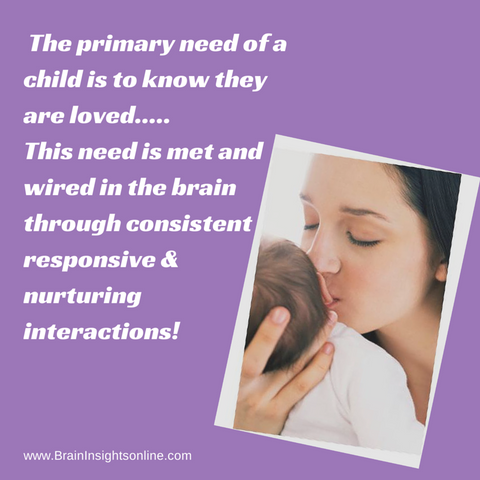
We are biologically designed for relationships. We are born with a primary need to get someone to care for us. We are completely dependent on at least one relationship with another person. Through the ideal situation of having someone lovingly and consistently respond to meet our needs in a nurturing way brain pathways for empathy are being created.

If an infant is responded to repeatedly and predictably in a caring way, this is going to create the feelings of safety and pleasure that her brain craves. This will begin the wiring in her brain for relationships with others in her life. So when infants consistently experience the give and take of a responsive relationship the basis for developing the skill of empathy occurs. Interestingly research conducted indicates that the brain areas for both empathy and violence are partially similar. These findings lead the researchers to state:

"We all know that encouraging empathy has an inhibiting effect on violence, but this may not only be a social question but also a biological one -- stimulation of these neuronal circuits in one direction reduces their activity in the other."

As a result a more empathetic brain will have more difficulty behaving in a violent way. While attending the sleep over party, my brain pathways likely fired in a way that found it too difficult to be mean to the new girl.

Various versions of interesting studies reveal that babies as young as 5 months old can demonstrate empathy skills. However, due to a variety of situations and circumstances some children do not experience the ideal serve and return relationships early in life. A child that does not experience the give and take of a relationship is simply not going to develop the brain connections for seeing things from another person’s point of view.

However the wonderful news is, the brain is always learning, re-organizing and making new connections throughout life. This is called, plasticity. This provides us with the extraordinary opportunity to make changes later. Of course it is best to develop a brain as optimally as possible in the first place, but it is significant to realize changes can be made through learning and repetition at other times in life. One remarkable program that is making an incredible difference in this way is a program called, Roots of Empathy.

Development of Empathy - An Essential Life Skill!  - https://braininsights.blogspot.com/


This project is based simply on a mother visiting a classroom with her baby on a monthly basis. The children are taught perspective taking through their interactions with the baby. The results have been dramatic. Humans are contagious beings. So, part of the effectiveness of this program is likely due to our contagious make up and these kids are “catching empathy experiences”. This contagious aspect seemed to be the case in the slumber party experience where the other girls joined me after I showed caring to the new girl. The repeated experiences of feeling empathy for a baby in the Roots of Empathy program are actually changing the brains of the children and this essential life skill is being learned.

Indicators are revealing that empathetic behaviors are in decline in many societies. There are numerous factors contributing to this occurring. So, since we are neuro-biologically meant to be connected to others, this needs to be realized and an emphasis of time spent on the development of relationships is critical.

In summary, valuing the time parents have to spend with their infants and young children and supporting parents in establishing a nurturing relationship is essential. Additionally, for daycares and schools to have an effective way to help children for success in life, is to have low teacher child ratios to increase the opportunity to foster relationships with every child. And then use the understanding that the brain is experience dependent. Children in schools can be engaged collectively in a caring climate and create activities that benefit other human beings.

Development of Empathy - An Essential Life Skill!  - https://braininsights.blogspot.com/


Children have the capacity to learn to read, write and do arithmetic … children also have the capacity to empathize. If we truly want to help children thrive in life ….and want to have an incredibly positive impact on our world, it is VITAL that we place the emphasis on the development of relationships with other human beings … This is where it all begins! After all it IS the primary need of the brain!

Development of Empathy - An Essential Life Skill!  - https://braininsights.blogspot.com/

This was a presentation I gave at Parenting 2.0 Talks 2014 Dublin, Ireland. September 2014

To book a presentation toward making a difference for your school, organization, agency or company send an email to: deb@braininsightsonline.com

For further information or for Brain Development Activity Packets go to:  BrainInsightsonline.com

DEVELOPING BRAINS NEED ATTUNED PARENTS AS MUCH AS THEY NEED NUTRITION

Thursday, December 2, 2010

Devoloping Brains Need Attuned Parents As Much AS They Need Nutrition! Developing brains need loving interaction, attuned parents, and touch as much they need nutrition. Early interactions set up the basis for expectations, self perception, self regulation, and relationships throughout life.

This video clip on Harry Harlow’s famous study demonstrates the critical need for security.


The amazing research explained in the following article, clearly shows the powerful influence that results from positive early care giving experiences: Good Parenting Triumphs Over Prenatal Stress.It is reassuring for expecting parents to know they can have this positive influence through a responsive and loving early relationship for their baby.

We can no longer let this information be ignored. This research ignites my desires to share all of this even more deeply (if that is possible!). My dream is to have the parent of every newborn learn how to easily provide the consistent care taking and loving interaction their baby NEEDS!  

So below are a few interaction tips from the Love Your Baby packet with brain development information from the baby’s perspective for you to share with every parent you know.


LOVING ME CALMS ME
Realize that loving me does NOT spoil me. Show the love you feel for me through all of the interactions we have together.

Brain Insight
Taking care of my needs does not “spoil” me. Comforting me when I need you helps me learn to trust that you will take care of my needs. I will be calmer as my brain learns I can expect you to take care of me.

SHOWING YOU THE ATTENTION I NEED
Notice how important your attention is to me. Tune into how I let you know when I need comforting or just a fun connection with you.

Brain Insight
Attention and contact with you is what matters most in this stage of brain development. The first 18 months are the most important for the foundation of my emotional development.

WHAT DO I LIKE?
Notice what I like and respond to. Try to tune in to the level of activity I seem to need. If I seem active, do a more playful activity. When I want to be calm, read a story, hold me close, or sing a lullaby to me. 

Brain Insight
My brain is not developed enough to adjust to different activity levels easily on my own. I really need you to match your behavior to my needs.


This is what every baby needs and wants every adult in their life to understand!


For more loving interaction ideas from the Love Your Baby brain packet in English or Spanish!

You will really enjoy being a part of the Worldwide Brain Team! You can get FREE monthly printables, parenting tips, learn about your own brain and get insights to share! It is so easy! Including a FREE Loving Your Baby print as a membership gift!!

Be a part and enjoy! Worldwide Brain Team http://www.braininsightsnow.com/index.php?page=wbtqanda


BRAIN FACT: Young Children Need Adults To Help Them Deal With Strong Emotions

Wednesday, August 25, 2010

Young children need adults to help them deal with strong emotions.  Immature brains are not able to control impulses or handle strong feelings on their own.

Bookmark and Share

BRAIN FACT: Young Children Need Adults to Help Them Deal With Emotions

Monday, June 28, 2010

Young children need the adults in their life to help them deal with big emotions. It is too much for an undeveloped brain to handle emotion on it's own.

Bookmark and Share
Related Posts with Thumbnails