Showing posts with label early brain development. Show all posts

Brain Development Hope

Friday, March 4, 2016

Brain Insights www.BrainInsightsonline.com

Brain Awareness Makes A Difference for All

Brain Insights - www.Braininsightsonline.com


Every year in March, The Dana Foundation encourages programs, agencies, organizations and individuals to participate in creating greater brain awareness. This year Brain Awareness Week will be 
the week of March 14-20th. 
To learn more go to Dana.Org

In support of this week, I am making a set of 10 FREE printables available to you! These include insights and a brain tip on a 
variety of topics from Birth -5.
 
A daily email will be sent beginning March 8th which will include an attachment of a downloadable PDF for you to print and share!

To receive these beneficial printables, simply fill out the contact form found at the bottom of the About Us Page on the Brain Insights website.

To add to the celebration a 20% discount on your entire order of 
Brain Insights Products is available now through 
Brain Awareness Week.   (March 3rd - March 20th)   
Promo Code:  BRAIN2016 

ENJOY!! 


LOVING INSIGHTS FROM A BRILLIANT NEWBORN

Sunday, April 5, 2015


Here I am!!! … Brand new to this world! 

Loving insights from a Brillinat Newborn http://braininsights.blogspot.com/2015/04/insights-from-brilliant-newborn.html How exciting this is… but, WOW it is also very scary!  It certainly was much calmer and warmer where I was living the last nine months.  Now, there are so many more sensations to deal with.  I am lying here all alone and I have no control about ANYTHING!  


How am I going to get my needs met?  I sure hope there is someone that will take care of me to keep me safe, make me feel secure or respond when I need something! 


Oh I hear that voice I got used to hearing. It makes me feel a bit calmer to hear something familiar. It sounds soothing as she talks to me.  


I am moving, this feels strange and also a bit frightening. I feel like I am falling. I startle and cry. Oh there, that feels much better.  She is cuddling me in her arms. I feel safe and warm here. I can feel her skin against mine. Hearing her heartbeat again along with her scent makes me feel very comforted. I hope she can see that I am showing through my relaxed body and my eyes looking at her eyes that I like all of this very much. If she notices that I like it, hopefully she will do this frequently. 


But …. I am beginning to feel some discomfort. It feels that I need to be fed. I hope she will know this is what I need now. I look around, squirm to see what I can find.


Oh no!  She doesn’t seem to know. I will show her with the way I move my tongue and position my mouth.  Oh good, she is watching.  She is imitating it back to me! She is showing me she knows what I was telling her! She is now feeding me!


It feels extremely wonderful to know that I can communicate my needs and have them understood. She recognizes that I am someone important, special, valuable and already quite brilliant! I really like her! 

Hopefully, she will stick around and this will continue! If all of this does happen repeatedly in this loving responsive way, it will create the critically important connections my brain requires to contribute toward enhancing the......

BEAUTIFUL UNIQUE BRILLIANCE THAT I AM!!


 Loving insights from a Brillinat Newborn http://braininsights.blogspot.com/2015/04/insights-from-brilliant-newborn.html


Together we can make a world of difference! 
It just takes understanding, 
caring and sharing!


Beautiful and Valuable Resources to help you support the healthy brain development and the love of the baby you care about:

You Are My World
How a parents love shapes a baby's mind (English or Bilingual)

The Blossom Method
The revolutionary way to communicate with your baby from birth

A Moving Child is a Learning Child
How the body teach the brain to think (0-7)

The Science of Parenting; 
How today's brain resarch can help you raise happy, emotionally balanced children

Elevating Child Care; A guide to respectful parenting   (English or Spanish)

Zero to Five; 70 essential parenting tips based on science

Love Your Baby; Making connections in the first year   (English or Spanish)


Loving A Baby; (Print in 3 versions)


Love A Child with Brain Insights! www.BrainInsightsonline.com

                                     Photo: Your Photos By Tracy; All rights reserved

Brain Insight to Share: Experiences Have an Enormous Impact!

Monday, October 13, 2014


 Making a Difference for the brain development of young Children - http://braininsights.blogspot.com/
  
 A BRAIN INSIGHT TO SHARE THIS WEEK!
 
 "The wiring of the brain of a young child is enormously impacted by the emotional environment it experiences frequently."


 Making a Difference for the brain development of young Children - http://braininsights.blogspot.com/


Related Article link for further information:


Research from Institute of Learning & Brain Sciences at the University of Washington

What are your thoughts on this research?


There is a growing group of individuals, organizations and companies wanting to make early brain development commonly and easily understood by EVERY adult for the benefit of EVERY child!
Join us to be a part of easily making brain development common knowledge! 
It only takes a couple of minutes each week! 
Simply cut and paste the Brain Insight above or use the social networking buttons to the right and share EVERYWHERE that is convenient for you! 

THE CHILDREN THANK YOU!! 

 “If we truly want to create a world of difference for children, it will happen through a common vision, shared knowledge, and dedicated hearts coming together with an intense desire to make change actually happen!”

Together Making a Difference for Children - http://braininsights.blogspot.com/


Brain Insight to Share: Learning to Handle Emotions

Monday, October 6, 2014

  
 A BRAIN INSIGHT TO SHARE THIS WEEK!
 
 "Young growing brains are too immature to 
handle big feelings. Children learn how to control impulses and handle strong emotions through the 
comforting adults in their lives."


Learning to handle emotions! Brain Insight to Share  http://braininsights.blogspot.com/

There is a growing group of individuals, organizations and companies wanting to make early brain development commonly and easily understood by EVERY adult for the benefit of EVERY child!
Join us to be a part of easily making brain development common knowledge! 
It only takes a couple of minutes each week! 
Simply cut and paste the Brain Insight above or use the social networking buttons to the right and share EVERYWHERE that is convenient for you! 

THE CHILDREN THANK YOU!! 

 “If we truly want to create a world of difference for children, it will happen through a common vision, shared knowledge, and dedicated hearts coming together with an intense desire to make change actually happen!”

Related Article link for further information: 

The Problem with Time-Outs 

From Psychology Today 


Is Your Child's Brain in Control?

Saturday, September 27, 2014


Sometimes it may seem that your child is being just “awful” and that their behavior is out of control. The thing is, their behavior actually may be “out of control”. 


The brain of your child is still maturing. This development takes many years. The part of the brain that regulates behavior and emotions is the last area of the brain to fully finish development. When this highest functioning brain area is developed, it will help to take control over big emotions and you will see the resulting better self controlled behavior.
 
But until then, your child REALLY needs you and all of the adults in their life to understand that they are not "being bad" and to help them through this process. They simply need you to help calm them and guide them through any difficult emotions that feel so incredibly overwhelming. 

Hunger and tiredness are two factors that have an incredible impact on the level of control your child has over their behavior. When your child does not get the sleep and nutrition their brain needs to function well, it makes it even more difficult to control all they are feeling.  Below are a couple of easy tips that may help ease your days together.


Tips to Try:
Do what you can to provide the sleep and nutrition the child’s brain needs every day. 


·   When a child has had enough sleep this helps keep brain systems in balance. Keeping bedtime and nap time at about the same time each day also contributes to better behavior.  

 
·   Providing a healthy breakfast that includes adequate amounts of protein also greatly helps behavior. When the brain gets the nutrition it needs to function well, the brain is less stressed and this results in children with a much more stable mood.


For the tips you need to EASILY help you during your busy life specifically for the age of your child....

 Brain Development Activity Packets at: 

www.BrainInsightsonline.com


The Development of Empathy... An Essential Life Skill!

Thursday, September 25, 2014


Development of Empathy - An Essential Life Skill!  - https://braininsights.blogspot.com/


Emotion has an enormous impact on imprinting memory in our brains. I had an experience when I was 6 years old that included emotion and have the memory of it all of these many years later.


It was a 6 year old birthday sleep over party. There were 7 girls invited that lived near each other and played together most days. A girl new to the neighborhood was invited only due to the requirement of the birthday girl’s mother. I was also invited.I lived a block away but did play with these girls fairly often. Being an extremely shy girl I really liked being accepted by this group and was excited to be included in the party.
The party progressed and it was now time to begin preparing for sleep. The new girl found a spot and laid out her sleeping bag on the family room floor. As she did this, one girl ran into the other room exclaiming how she was not going to put her sleeping bag anywhere new this new girl. The other girls followed running into the other room expressing the same plan. Even though I was silent, I also followed the group into the other room. As I stated it was very important to me to feel a part of this group.

Once in the other room, I turned around and saw the girl sitting all alone on her sleeping bag looking very dejected. At that moment an intense feeling of empathy overcame me. With this strong feeling, I picked up my sleeping bag, went into the other room and laid it out right next to the girl who was being excluded. To my surprise, the other girls followed and the party resumed.

The ability I had to see things from her perspective and the resulting empathy I had for this girl in this situation strongly overcame my need to be accepted by the group.
Brain research demonstrates that even very young babies have a capacity for empathy. This is an extremely essential life skill and is at the heart of social skills and success in life. It is a skill like any other, it needs to be developed.

As Dr. Bruce Perry, an expert on the development of and need for empathy, states:

 "One of the most important aspects of being a human being, is being able to be in a relationship. Being able to successfully form and maintain a relationship. And at the heart of that capability is the capacity to put yourself in somebody else's shoes, to see the world how they see it. That capacity is empathy."

As my career unfolded, I became extremely interested in early brain development research and now have the goal of making it commonly understood…. and that goal is only to have it understood by EVERY adult in this world! The impact of early relationships is an area of major focus in this work.

Development of Empathy - An Essential Life Skill!  - https://braininsights.blogspot.com/


The brain is experience dependent, meaning development doesn’t just magically happen. A brain develops based on the combination of the genes a child is born with and the experiences that a child has after birth. The pre-school years are like the fourth trimester in rapidly connecting the 100 billion brain cells we are born with. Experiences create a direct and physical impact on the way a brain is wired. And the repetition of experiences strengthens these essential neural connections.

The brain is designed to adapt to whatever type of experiences are repeated most frequently…. whether positive or negative. Even though it takes many years for the brain to fully mature, these early months are the time for the most rapid amount of growth and development of the brain… with 85% of growth by age three.

Development of Empathy - An Essential Life Skill!  - https://braininsights.blogspot.com/


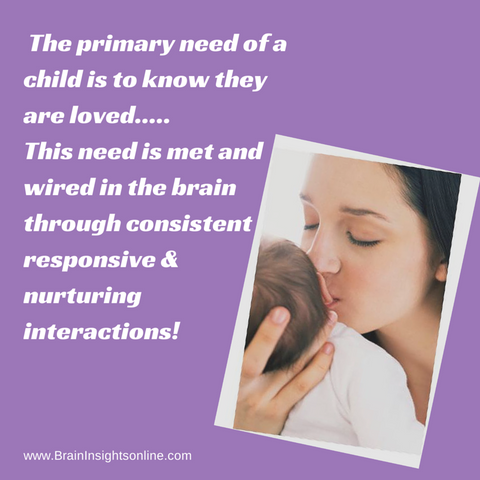
We are biologically designed for relationships. We are born with a primary need to get someone to care for us. We are completely dependent on at least one relationship with another person. Through the ideal situation of having someone lovingly and consistently respond to meet our needs in a nurturing way brain pathways for empathy are being created.

If an infant is responded to repeatedly and predictably in a caring way, this is going to create the feelings of safety and pleasure that her brain craves. This will begin the wiring in her brain for relationships with others in her life. So when infants consistently experience the give and take of a responsive relationship the basis for developing the skill of empathy occurs. Interestingly research conducted indicates that the brain areas for both empathy and violence are partially similar. These findings lead the researchers to state:

"We all know that encouraging empathy has an inhibiting effect on violence, but this may not only be a social question but also a biological one -- stimulation of these neuronal circuits in one direction reduces their activity in the other."

As a result a more empathetic brain will have more difficulty behaving in a violent way. While attending the sleep over party, my brain pathways likely fired in a way that found it too difficult to be mean to the new girl.

Various versions of interesting studies reveal that babies as young as 5 months old can demonstrate empathy skills. However, due to a variety of situations and circumstances some children do not experience the ideal serve and return relationships early in life. A child that does not experience the give and take of a relationship is simply not going to develop the brain connections for seeing things from another person’s point of view.

However the wonderful news is, the brain is always learning, re-organizing and making new connections throughout life. This is called, plasticity. This provides us with the extraordinary opportunity to make changes later. Of course it is best to develop a brain as optimally as possible in the first place, but it is significant to realize changes can be made through learning and repetition at other times in life. One remarkable program that is making an incredible difference in this way is a program called, Roots of Empathy.

Development of Empathy - An Essential Life Skill!  - https://braininsights.blogspot.com/


This project is based simply on a mother visiting a classroom with her baby on a monthly basis. The children are taught perspective taking through their interactions with the baby. The results have been dramatic. Humans are contagious beings. So, part of the effectiveness of this program is likely due to our contagious make up and these kids are “catching empathy experiences”. This contagious aspect seemed to be the case in the slumber party experience where the other girls joined me after I showed caring to the new girl. The repeated experiences of feeling empathy for a baby in the Roots of Empathy program are actually changing the brains of the children and this essential life skill is being learned.

Indicators are revealing that empathetic behaviors are in decline in many societies. There are numerous factors contributing to this occurring. So, since we are neuro-biologically meant to be connected to others, this needs to be realized and an emphasis of time spent on the development of relationships is critical.

In summary, valuing the time parents have to spend with their infants and young children and supporting parents in establishing a nurturing relationship is essential. Additionally, for daycares and schools to have an effective way to help children for success in life, is to have low teacher child ratios to increase the opportunity to foster relationships with every child. And then use the understanding that the brain is experience dependent. Children in schools can be engaged collectively in a caring climate and create activities that benefit other human beings.

Development of Empathy - An Essential Life Skill!  - https://braininsights.blogspot.com/


Children have the capacity to learn to read, write and do arithmetic … children also have the capacity to empathize. If we truly want to help children thrive in life ….and want to have an incredibly positive impact on our world, it is VITAL that we place the emphasis on the development of relationships with other human beings … This is where it all begins! After all it IS the primary need of the brain!

Development of Empathy - An Essential Life Skill!  - https://braininsights.blogspot.com/

This was a presentation I gave at Parenting 2.0 Talks 2014 Dublin, Ireland. September 2014

To book a presentation toward making a difference for your school, organization, agency or company send an email to: deb@braininsightsonline.com

For further information or for Brain Development Activity Packets go to:  BrainInsightsonline.com

Calmer Mornings and Better Moods for Your Family!

Thursday, February 13, 2014

Routines are important for calmer brains 
and for Families!


Did you know  the brains of children really like routines... and do not like chaos? Predictability is comforting.


Mornings certainly can be a trying time for families.   
As a caring parent you have the challenge of trying to get a lot accomplished in a short amount of time and want to leave home with everyone in a positive mood, ready for learning … and all wearing shoes!
Through understanding brains and trying some of the following tips, you will be able to more easily reach this goal! 
    
Establish daily routines
Consistent routines that happen in nearly the same way each day, provide a sense of predictability for young children. The brain feels comfortable and safe when it knows what to expect next. 
Tips:
  • Set a schedule. When children know what happens first, next and last, this reduces the need for you to give constant reminders. Children become more self-directed as a result of an established routine.
  • Start the routine with a healthy breakfast. Eating a well balanced breakfast that includes adequate amounts protein provides the brain with the nutrients to function well. Research shows children who eat a healthy breakfast a have a more stable mood throughout the day.
Early brain development tips on nutrition from Brain InsightsHowever, eating sugary cereal, doughnuts, or sweetened juices will result in the brain needing food again only 30 minutes later. The brain then feels stress and releases stress chemicals. As a result a child may experience feelings of agitation, aggression, and anxiety. Young developing brains do not yet know how to control all of these feelings. This is why it is called, "out of control" behavior.
  • Ensure everyone has had enough sleep. Sleep enhances cognitive functioning and influences moods. Having enough sleep contributes to a more positive mood. When the brain lacks the sleep it needs, brain systems become out of balance. Children's (and adult) brains become more easily agitated when sleep deprived. 
            
  • Do all you can to keep bedtimes and bedtime routines as consistent as possible.
  • Provide calm activities like reading a book, giving a massage, taking a warm bath, or listening to soothing music as part of the bedtime routine.
  • Eliminate watching television or using other electronics with bright lights prior to bedtime routines.
  • Provide "brain calming" foods as a bedtime snack such as warm milk, a banana, toast with almond butter, or oatmeal with a bit of peanut butter added.
Realize that your child doesn’t have a motivation to get out of the house quickly. 
A child’s brain prefers to play, have fun, and to spend time with you.  Your mature brain has the ability to override your desires to sit and have another cup of coffee, read the paper, take a
walk… etc. (Well most days anyway!)
Brain Insights tips for positive morning routines #OlympicDads 
Tips: 
·      Use games to help motivate children. These also create a fun time spent together before having to separate for the day.
  • Game Example:
STOP AND GO
Have your child start to get dressed, Say, “Go”.
Tell the child to keep going until you say, “Stop”.
Repeat this with varied long and short and long periods of time getting dressed.
  • Turn on upbeat and fun music. Encourage your child to finish dressing by the time a song ends.
  •  Use empathizing statements with an understanding tone of voice, such as, “I know, sometimes you don’t like to get going early.”  Or “I understand how much you would rather be playing right now.”   Sometimes just knowing that someone else recognizes feelings, helps a child cope.
  •  Provide choices. When children are given options and are more directly involved in the activity, this results in more cooperation. For example:  Ask, “Would you like to brush your teeth or comb your hair first?”.
Children’s brains pick up on emotional atmosphere very quickly…. And react to your stress level. 
#Olympicmom morning routhine tips from Brain InsightsReduced levels of stress lead to better memory, better problem solving, and increased ability to pay attention.
Tip:
·       
       As tired as you might be, you can reduce stress levels by doing as much as you can in the evening. You can give baths, pack diaper bags/school bags, read/sign papers sent from school, prepare your work bag and lunches, lay out clothes, socks, shoes, and jackets, etc.

    When it is then time to separate for the day, your child will likely feel more ready to go! 


The additional brain tips you need to make your life easier are available in the Brain Insights Activity Packets. Have one right on hand specifically for your child's age!


Related Posts with Thumbnails