INVESTING IN CHILDREN

Friday, February 3, 2012

 
As you know the reason I created, braininsights, is because as I do brain presentations and communicate with others throughout the country, I have found that most adults do not yet know all that is best for developing brains. My goal is to change this, and make early brain development common knowledge. So in this issue of the January Issue of the Brain Insights Newsletter, I have asked the following question.. 
 

Why is this the case? Why is it that we have more knowledge than ever before about what is best for children's brain development ... and yet this IS NOT what is what most children are experiencing?


My concern is ... How can we get EVERYONE to understand the importance and the impact of the early years? ~ We know more than ever about all that children need most for optimal development, but too frequently children are experiencing just the opposite. Too many children are not getting the healthy foods they need, are pushed toward academics too early, are spending time with screens instead of learning in the way the brain learns best, are living in harsh or chaotic environments and/or over scheduled lives.
 The wonderful thing is that there are numerous and wonderful individuals, organizations and companies working and sharing to create the understanding that children need safe, predictable, nurturing relationships, healthy environments and nutrition. They also promote, how children need opportunities to play, move, experience nature and learn through exploring. I am very anxious for this to be common knowledge... but even more important... common practice!! 

  Read more about this perplexing question in the January Newsletter
You will also find a variety of articles and sources of information contributing to finally make this happen. 

Let's invest in our young children and have this occur in 2012!

Enjoy all of the great articles and resource links!! 

Baby Brain Thought

Tuesday, January 31, 2012


"I want EVERY adult that influences my life to realize all that impacts my brain development in the early months and years of my life!"

"My hope is that EVERY adult understands that providing loving, safe, healthy, predictable, nurturing, and stimulating environments allows me to reach my full potential....
Can you help to make sure NONE of them will ignore this amazing opportunity so I can develop in the best way possible?" 


Naptime Is Great!

Tuesday, January 17, 2012

Naptime is much more than providing rest for a child ... and a break for parents! Children's developing brains need adequate amounts of sleep for healthy brain development.

We all know what it is like to deal with an over tired child. The reason for the behaviors we experience is due to a child not being able to handle the results of inadequate amounts of sleep. First of all the child still has an immature brain. It hasn't developed enough to provide the ability to deal with feelings of brain systems being out of balance. This is even difficult for adults. Getting enough sleep helps keep brain systems in balance. When children have had enough sleep it enhances cognitive functioning and moods.

New research lead by the University of Colorado Boulder reveals that, "toddlers between 2 and a half and 3 years old who miss only a single daily nap show more anxiety, less joy and interest and a poorer understanding of how to solve problems." 


Assistant Professor Monique LeBourgeois of CU Boulder led the study. She states, “This study shows insufficient sleep in the form of missing a nap taxes the way toddlers express different feelings, and, over time, may shape their developing emotional brains and put them at risk for lifelong, mood-related problems.”


Additionally LeBourgeois shares, “Just like good nutrition, adequate sleep is a basic need that gives children the best chance of getting what is most important from the people and things they experience each day,”

Read more about the research from the University of Colorado Boulder press release shared on this site.

Recommended amounts of sleep and tips on promoting sleep are shared in SLEEP ENHANCES COGNITIVE FUNCTIONING AND INFLUENCES MOODS.

Sleep well! 


A Nature Preschool Enhances Early Childhood Brain Development

Monday, January 9, 2012


As I continuously promote, it is critical that children have the opportunity to learn, play and explore outdoors. As adults we need to do all we can to ensure that children have opportunities to develop their brains in healthy, natural and safe environments.

There are numerous benefits to brains of all ages as a result of spending time in nature as I have shared in Your Brain Needs Nature and this fun one that includes a video called, Nature Deficit Disorder by KQED QUEST. It is especially important and beneficial for young developing brains to experience and learn outdoors.

For this reason I am thrilled to share the following article from Audubon magazine. It is a great pleasure  to work with the extremely talented and dedicated people and spend time at the Schlitz Nature Audubon Nature Center. It has been a particularly great honor to collaborate on a project to create the Naturally Developing Young Brains Packet with Lorna Hilyard and Pattie Bailie, mentioned in this article.

I am certain you will enjoy reading the experience expressed by one Dad after his son spent only two weeks in the nature preschool. The center is remarkable. The best part is, they serve as a model and help other programs implement nature into programing. In fact 10% of the proceeds from the sale of the nature brain packets goes directly toward increasing nature preschool experiences for more children.

A Nature Preschool Enhances Early Childhood Brain Development 

An exciting nature-based curriculum for preschoolers developed at the Schlitz Center in Wisconsin is spreading to classrooms across the country—and even to Sesame Street. 

By Susan Cosier  Published: January-February 2012 

"Bailie, a 20-year veteran of early childhood and environmental education, says, “There’s such a connection between spending time in the natural world and the developing brain.”

Recent research bears her out, though it’s an understudied field. Noticing differences between objects, like seeds and burrs, helps wire the brain, nurturing initial math and pre-reading skills that develop from the ages of one through four. “They learn observation skills after just a few months,” says Bailie. “Parents will tell me, ‘I can’t believe what my child sees now.’ "Studies also show that just 20 minutes spent outdoors improves concentration in children with attention-deficit hyperactivity disorder as much as, if not more than, medication. That’s in addition to the physical benefits of exercise and exposure to vitamin D (which helps build strong bones)."    Read More


It would be great to hear your experiences with children as a result of spending time outdoors. Please share your wonderful stories with all of us!

For more information about or to purchase, Naturally Developing Young Brains go to Brain Insights


LOVE IS A PRIMARY NEED

Tuesday, December 20, 2011


Did You Know...?
        
...... feel good chemicals are released in the brain through loving interactions.

....... families and cultures that express warm physical affection have fewer issues with anger and aggression.

..... Researchers who examine the life histories of children who have succeeded despite many challenges, have consistently found that these children have had at least one stable, supportive relationship with an adult early in life.


It is valuable to realize how much the brain has to do with relationships and the love we experience in our lives. Love is one of our primary needs throughout our lives. 

Warm, responsive care-giving not only meets a child's basic day-to-day needs, but is also about responding to the emotional needs of children. Predictable and loving responsiveness is not only comforting, it plays a vital role in optimal mental health. The way that parents, families and other caregivers consistently relate and respond to young children, directly create influences learning and relationships later in life. 

This all begins in infancy but does not end there. This is why I love to share the writing of Mark Brady, Ph.D. on what he calls, "Big Brain Question". Below are some pieces from his contributions on this topic.


The healthy brain is an anticipation-prediction machine. When we operate in environments where there is little predictability and we have little idea what to anticipate from one moment to the next, chronic stress results.

There’s ONE question that all brains want answered, and they want it answered, “Yes.” Parent’s brains, children’s brains, all brains. And they don’t want a lukewarm “Yes,” or a “Maybe Yes” or a “Getting-to-Yes Yes.” They want a substantial, resounding, unequivocal, “YES!” Yes. When the answer is something other than “Yes.” if the answer is “Maybe,” or “I’m not sure,” a confusion and uncertainty begins to take shape in our brains.

The Question our brains ask is …… Are you there for me?
Do I matter enough that you’ll put me first when I need you to? Can I count on you to attend to me in the ways I need you to? Do I truly and deeply matter to you?

These questions are being asked – non-verbally through behavior often, and when they get answered “Yes,” we can relax and begin to feel safe in our relationships. The self-preservation structures of the brain continually monitor our environment and the people in it for safety. Our survival depends upon it. We generally love the people we feel the safest being around, and the emotional responsiveness often identified as love arises out of this safe “felt sense.” 

My dream is for all children to grow with this
loving safe and secure experience!

…..I also hope you and all those you care about have a new year filled with the opportunity to both give and receive this wonderful feeling!


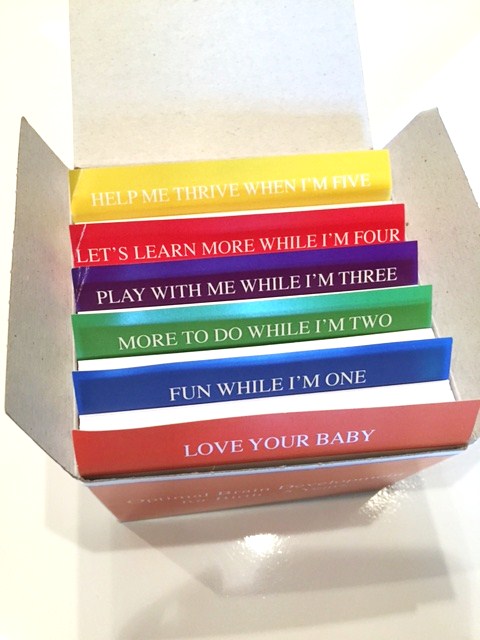
The impact loving interactions can make on a child’s growing brain, is one of the primary reason I developed The Brain Development Series, You can purchase brain packets in English or Spanish.

REALLY IMPROVING BRAINS!

Sunday, December 11, 2011


I am so excited to share the following with you! It is a wonderful poem sent to me by Hillary at Toys Naturally. She was inspired and wrote it in response to the article I posted on ipadding for toddlers and a few other recent posts on this important topic. This is one I am going to share often to communicate the importance and incredible value of interaction with people and real objects vs screen time. Enjoy the insights Hillary shares!


I read a tweet and saw a blog
Young minds, affected, in a fog
Television, switched on all day
Destroying childhood, killing play

I felt virtuous - only half an hour
My wee one was a protected flower?
I thought some more and then said why?                    
No TV a few days c’mon-let’s try

Next day we did not switch it on
Instead played blocks and had some fun
Out came play dough and some books
Lots of cuddles and a few funny looks

Out came the tea set and a teddy bear
Bottomless pretend tea and cookies to share
On goes music and we go grooving
Wow yes it’s true our brains, improving

That half an hour, we have it back
To play, to share, to have a yack.
As I chop and cook a dinner for 3
My wee one plays and enlightens me.


The Brain Development Series was developed for this exact purpose. They were created with this scene in mind. Each packet is filled with ways to easily provide this opportunity for every child and family! 


I am thrilled by the beautiful toys provided by Toys Naturally. You can visit the site here to order wonderful products for the young growing brains in your life! 

Children and the Brain: Think Big!

Wednesday, November 30, 2011

What is good for the body... is good for the brain!

Often when we hear the term "healthy" we generally think in terms of our body. However, realizing the positive impact healthy habits have on our brains and the dramatic effect they have on children can make an remarkable difference.

When I am presenting on the effects nutrition has on a child's brain, learning and behavior, I commonly find that people are amazed with this knowledge. This is the reason for my post today. I am sharing this wonderful article written by Lauren Zimet which was previously published in Common Ground Magazine, Nov 2011.
I have had the pleasure of co-presenting with Lauren. She is a dedicated, knowledgeable and passionate professional. 
Enjoy the valuable tips she provides for the benefit of healthier brains for everyone!


Nourishing Tips to Nurture New Neurons
BY LAUREN ZIMET

The brain. We all have one. Yet sometimes it gets neglected. Our brain needs certain things to stay healthy, and when it doesn’t get what it needs, it doesn’t work its best. In fact, sometimes it gets the opposite of what it needs—stuff it doesn’t know what to do with, such as artificial dyes, preservatives, GMOs, the list goes on. When this happens, both our brain and body can have a sensitive reaction that can look different from one person to the next, but that can result in a brain not performing to its highest standard.


We are born with 100 billion brain cells, and the brain continues to develop after a baby is born. New connections between neurons—the cells in the brain—form quickly from birth to 3 years of age and older, and continue to form
throughout our lives, based on our experiences.This means that we need to
nourish our brain. We need to give it both the experiences and the nutrients it needs to develop.

It helps children to know that with each healthy food they eat, and with each new experience they have, they are making a new connection in their brain.
This is powerful stuff . Imagine a child, face filled with pride, after making a new neural connection by simply taking a nibble of kale.

The following seven tips offer
simple ways you can guide your
children in making mindful, brain-healthy
choices as they play, learn, work, and grow.

1. Eat a rainbow. Eat a colorful array of organic
fruits and vegetables every day. Be sure
to wash the produce to loosen and rinse away
any dirt and toxins. Kids can do the washing—
they benefit from being part of a team, by having
their own chores within the family.

2. Don’t eat fake stuff. The body really likes
food. Real food, such as whole grains, protein,
lots of colorful vegetables and fruit, and
healthy fats. Limit or eliminate artificial dyes,
colors, and flavors; processed foods; fast foods;
junk foods; hydrogenated fats; sodas; and refined sugars.

3. Keep your brain lubed. Your brain needs
omega-3s, also known as essential fatty acids
(EFAs), for proper growth, particularly                                      
for neural development
and maturation of sensory systems.
EFAs speed neural signals
along, making for smoother,
easier, more efficient communication
across synapses. EFAs are
necessary for proper immune
function, cognitive development,
and for skin function and
maintenance. A deficit in EFAs
has been linked to ADHD, dyslexia,
and other behavioral and
psychological disorders. Your
body can’t make EFAs, so you
need to consume them. They are
found in nuts, seeds, olives, seaweed,
and fish. It’s always best to
eat foods that contain vitamins, minerals, and
other essential nutrients, but if you are unsure
that your child is getting a well-balanced diet,
a purified, molecularly distilled fish oil supplement
is a great EFA source. My trusted brand
of choice is Nordic Naturals.

4. Stay awash in oxygen and water. Drink
H2O to hydrate—check with your health care                    
practitioner for how much, but a quick rule is
to divide your body weight by two to get the
approximate number of ounces to drink per
day. Also, take slow, deep breaths to reset and
calm the sensory and neurological system.
Deep breathing helps children self-regulate
and improves immunity, nervous system functioning,
and emotional regulation. A recent
study published in the International Journal of
Nursing Studies reports that deep breathing is
effective for reducing anxiety in children with
asthma.


5. Learn to move and to chill. The brain
loves exercise, and exercise boosts brain power.             
But you also need to teach your child how
to relax—for example, by getting out into nature,
reading an entertaining book, or playing
a board game. Long-term stress can be toxic,
and a stressed brain doesn’t learn the same way
as an unstressed brain. Emotional stress has an
impact on a child’s ability to learn. Sustained
stress can damage a developing brain’s architecture,
which can lead to problems in learning,
behavior, and physical and mental health.

6. Rewire your thinking. Create “Band-Aid
thoughts” as a tool to acknowledge and work
through bad, sad, mad, frustrated, and negative thoughts.
Demonstrating positive self-talk in front of your children—
for example, reflecting on how you expertly handled a 
difficult or challenging situation—lays a blueprint for how
they may handle their own problems. Negative
thoughts or mistakes can be opportunities to
learn and grow from.

7. Name that feeling. Teaching your child
to label emotions and recognize feelings helps
connect the nonverbal and verbal pathways in
the brain. Strengthening these pathways can
improve a child’s ability to take on another’s
perspective. This is especially useful for children
with learning challenges, who need more
support developing flexible thinking.


Lauren Zimet, MS, CCC/SLP, is the founder of
Healthy Foundations, an education program
that facilitates brain health, nutrition education,
and social thinking for children of all ages
Related Posts with Thumbnails